
Caring for the public is a mutual pathway to policy leadership as it focuses on population health, health care disparities, and identifying systemic solutions to population problems (Patton, Zalon & Ludwick, 2014). Public health is one of the main priorities of both public and private sectors. In this blog, we are going to discuss about Private Sectors and their contribution with policy leadership regarding Antibiotic Stewardship.
What is a Private Sector?
The Private Sector include businesses and non-governmental agencies who are dedicated in helping the society obtain better quality of life and health care outcomes (Patton, Zalon & Ludwick, 2014). These organizations also work with the public sector (government agencies) to gain better support in achieving their goals.
Health policymaking in the Private Sector
According to Longest (2009), Private Sector policies are authoritative choices established by executives of healthcare organizations with regards to issues as their product lines, pricing and marketing strategies. For example, the Joint Commission which is a private accrediting body for health-related organizations and the National Committee for Quality Assurance which is a private organization involved in evaluating and reporting on the quality of accomplished care plans. Both organizations make their own health policies to attain their goals and to comply with the government’s requirements for them. Despite the government having a huge part in health policies, they still need help from the private sectors for resources. Therefore, the public sector needs the private sector and vice versa to attain better health outcomes for the community.
Here are some examples of Private Sectors who are involved in eradicating Antibiotic Resistance:
- Infectious Diseases Society in America
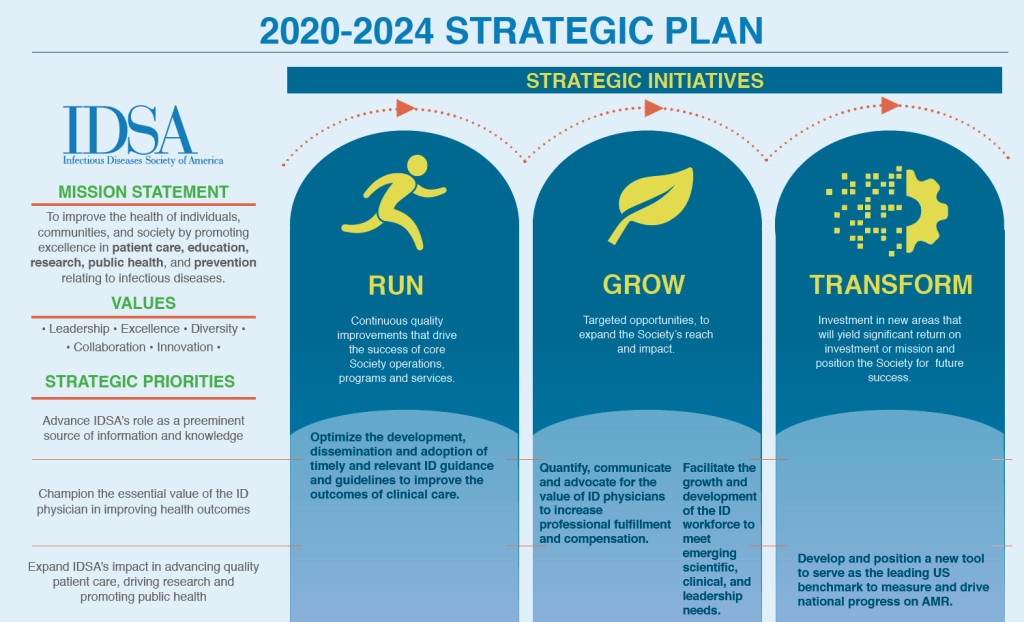
This organization consists of more than 12,000 physicians, scientists and public health experts who focuses in infectious diseases. Their purpose is to “improve the health of individuals, communities, and society by promoting excellence in patient care, education, research, public health, and prevention relating to infectious diseases”. One of the strategic initiatives of this organization is to develop and position an innovative tool to aid as the top US point of reference to measure and drive national progress on Antimicrobial Resistance (Infectious Diseases Society in America, 2020). In addition, IDSA has formed a program to elect Antimicrobial Stewardship Centers of Excellence (CoE) all throughout the U.S. health care system.
The IDSA Antimicrobial Stewardship Centers of Excellence Program builds upon the criteria set forth in the CDC Core Elements with added features of meaningful differentiation. The Core Criteria for the IDSA Antimicrobial Stewardship Centers of Excellence were established by a workgroup of infectious disease physicians and infectious disease trained pharmacists (Infectious Diseases Society in America, 2020).
2. Association for Professionals in Infection Control and Epidemiology (APIC) Antimicrobial Stewardship
APIC (n.d.) is a leading professional association for infection preventionists with more than 15,000 members consisting of nurses, physicians, public health professionals, epidemiologists, microbiologists, or medical technologists who:
- Collect, analyze, and interpret health data in order to track infection trends, plan appropriate interventions, measure success, and report relevant data to public health agencies.
- Establish scientifically based infection prevention practices and collaborate with the healthcare team to assure implementation.
- Work to prevent healthcare-associated infections (HAIs) in healthcare facilities by isolating sources of infections and limiting their transmission.
- Educate healthcare personnel and the public about infectious diseases and how to limit their spread.
APIC (n.d.) also holds a public health agenda which includes Antibiotic Resistance. The projected $200 million in funding would:
- Expand Hospital acquired infections and antibiotic resistance prevention efforts from 25 states to 50 states, six large cities, and Puerto Rico;
- Sustain an Antimicrobial Resistance Laboratory Network of up to seven AR Regional Labs to serve as a national resource for cutting-edge lab support to states and characterize emerging resistance;
- Implement antibiotic stewardship programs that align with CDC’s Core Elements for Antibiotic Stewardship in inpatient, outpatient, and long-term care settings;
- Drive innovation through the CDC’s Prevention EpiCenters network collaboration with academic research centers conducting applied research on interventions for infection prevention;
- Incorporate NHSN antibiotic use data to improve prescribing practices.
Knowing the importance of what the public and private sectors do to help the community is necessary for us healthcare professionals so that we could provide input on these projects that they are implementing and create partnerships to eradicate Antibiotic Resistance.
References
Association for Professionals in Infection Control and Epidemiology. (n.d.). About APIC. Retrieved from https://apic.org/about-apic/about-apic-overview/
Association for Professionals in Infection Control and Epidemiology. (n.d.). Antibiotic Resistance. Retrieved from http://cqrcengage.com/apic/antibioticresistance
Infectious Diseases Society in America. (2020). About IDSA. Retrieved from https://www.idsociety.org/about-idsa/about-idsa/
Infectious Diseases Society in America. (2020). Antimicrobial Stewardship Center of Excellence. Retrieved from https://www.idsociety.org/clinical-practice/antimicrobial-stewardship/
Longest, B. B. (2009). Health Policymaking in the United States: Vol. 5th ed. Health Administration Press.
Patton, R. M., Zalon, M. L., & Ludwick, R. (Eds.). (2014). Nurses making policy: From bedside to boardroom. Retrieved from https://ebookcentral-proquest-com.ezproxy1.lib.asu.edu
 Antibiotic Resistance in long-term care facilities in Arizona