Featured

My First Blog Post

Antibiotic Resistance:

A National Priority

Working as a nurse, I have seen how providers have ordered antibiotics unnecessarily. I have worked in a country where pharmacies do not require consumers to have a prescription for antibiotics, do if someone gets sick, people will automatically go to the pharmacy and self-medicate themselves with these medications. I have worked with doctors where common colds can be “cured” by antibiotics. Having these perceptions that “Antibiotics can treatment everything” had stemmed from the discovery of Penicillin in 1928 by Alexander Fleming (Centers for Disease Control and Prevention (CDC), 2019) and our reliance to antibiotics has taken its toll. Unnecessary antibiotic administration has led to increasing incidences of infections that are resistant to antibiotics, making it harder and sometimes impossible to treat (World Health Organization (WHO), 2018). Since antibiotic resistance may affect the healthcare, veterinary and agricultural industries, it is one of the most serious public health problems globally. There is an estimated 2.8 million people in the U.S. have antibiotic resistant infection and more than 35,000 die from it (CDC, 2019).

Antibiotics is one of the most commonly prescribed medications in long term care facilities making it dangerous for the frail residents if administered inappropriately. According to the CDC (2015), 70% of the residents residing in nursing homes get one or more courses of systemic antibiotics in a year but 40-75% of antibiotics prescribed were unwarranted or inappropriate. As a result, the risk for Clostridium difficile, heightened adverse drug outcomes and drug interactions, and colonization and/or infection with antibiotic-resistant organisms may occur in this population (CDC, 2015; WHO, 2018). Since nursing home residents are at high risk of acquiring infection due to immunosuppression, functional and cognitive impairment, the inability to convey symptoms may lead to assumptions in antibiotic prescribing (Van Buul et al. (2015). Therefore, healthcare organizations were forced to create and implement methods to eliminate this problem.

The United States government has been determined to eliminate antibiotic resistance, deeming it as a national priority. Mandates such as U.S. National Strategy for Combating Antibiotic-Resistant Bacteria (National Strategy) and a supplementary U.S. National Action Plan for Combating Antibiotic-Resistant Bacteria (National Action Plan) were implemented to promote Antibiotic Stewardship in all sectors like healthcare, veterinary and agricultural industries. According to the CDC (2019), federal organizations are working together to:

  • Respond to new and ongoing public health threats
  • Strengthen detection of resistance
  • Enhance efforts to slow the emergence and spread of resistance
  • Improve antibiotic use and reporting
  • Advance development of rapid diagnostics
  • Enhance infection control measures
  • Accelerate research on new antibiotics and antibiotic alternatives

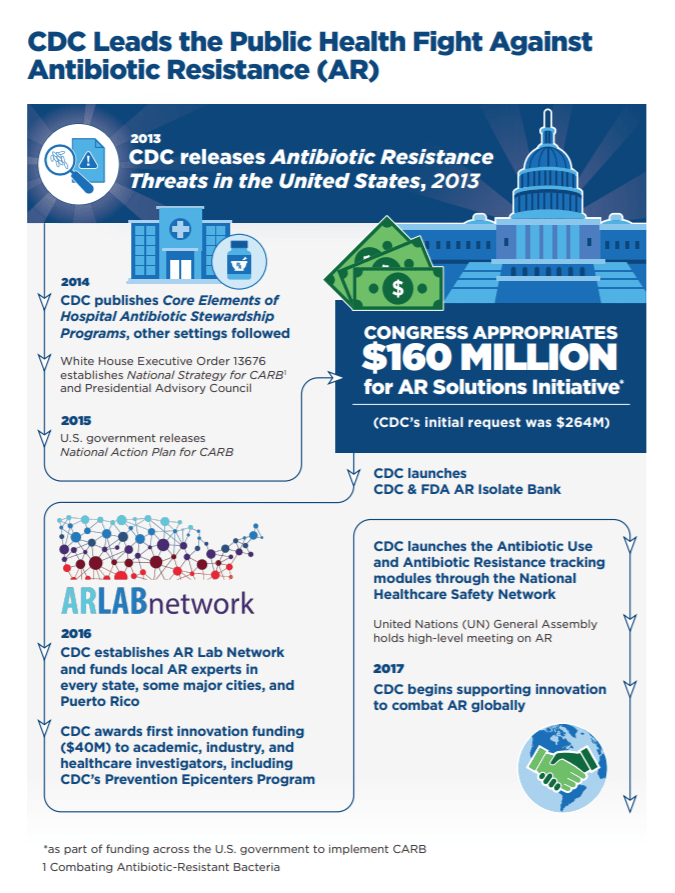
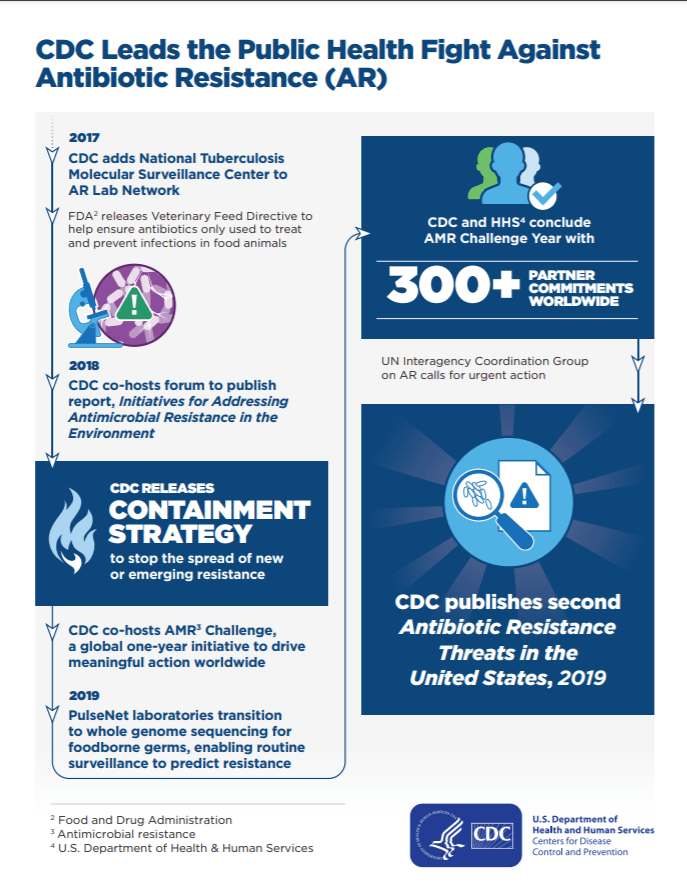
Here is a link of the timeline of the actions done by the government to fight antibiotic resistance: https://www.cdc.gov/drugresistance/pdf/threats-report/CDC-Leads-AR-Fight-508.pdf

In addition, the United Nations (2016) acknowledged that the best practice for managing infections is improved awareness on Antibiotic Resistance. In 2016, the U.S. Congress granted $160 million to the CDC to execute Antibiotic Resistance Solutions Initiative and promote Antibiotic Stewardship (CDC, 2018). The Center for Medicare and Medicaid Services (2018) included the provision of Antibiotic stewardship programs as part of their Long term care facility requirements to practice safe healthcare delivery effective on 2016. Also, the CDC (2016) advocates the implementation of an antibiotic stewardship program following the seven core elements and that all nursing homes develop better antibiotic prescribing practices and decrease unnecessary prescription. Here is the link for the Core Elements of Antibiotic Stewardship for Nursing Homes: https://www.cdc.gov/longtermcare/pdfs/core-elements-antibiotic-stewardship.pdf

            In Arizona, the Arizona Department of Health Services (AZDHS) has put into effect a Healthcare Associated Infection (HAI) Advisory Committee to create potential roles and activities to improve antibiotic use in the state like antibiotic stewardship. This involves surveillance, research, creating metrics for measuring advancement towards meeting the national goals and ongoing communication and partnerships with other organizations like Arizona Infectious Disease Society, Arizona Hospital and Healthcare Association and the Arizona Pharmacy Association (AZDHS, 2016).

            Executing Antibiotic Stewardship programs in nursing homes can be tough due to inadequate resources. However, through the help of the government and the support of all healthcare professionals, strategic approaches can be applied with minimal expense and effort. Following a stepwise tool for easy understanding, allocating roles, repeated reminders of Antibiotic Stewardship essentials, success will be attained.

References

Arizona Department of Health Services. (2016). Healthcare-associated infection (HAI) & Antibiotic resistance. Retrieved from https://azdhs.gov/preparedness/epidemiology-disease-control/healthcare-associated-infection/index.php#plan

Centers for Disease Control and Prevention. (2015). The core elements of antibiotic stewardship for nursing homes. Atlanta, GA: US Department of Health and Human Services

Centers for disease control and prevention. (2017). Antibiotic use in the United States, 2017: Progress and opportunities. Retrieved from https://www-cdc-gov.ezproxy1.lib.asu.edu/antibiotic-use/stewardship-report/pdf/stewardship-report.pdf

Center for Disease Control and Prevention. (2019). About antibiotic resistance. Retrieved from https://www.cdc.gov/drugresistance/about.html

Center for Disease Control and Prevention. (2019). U.S. action to combat antibiotic resistance. Retrieved from https://www.cdc.gov/drugresistance/us-activities.html

Centers for Medicare and Medicaid Services. (2018). Medicare and Medicaid programs; reform of requirements for long-term care facilities. Retrieved from https://www.cms.gov/Medicare/Provider-Enrollment-and-Certification/GuidanceforLawsAndRegulations/Nursing-Homes.html

United Nations. (2016). Draft political declaration of the high-level meeting of the general assembly on antimicrobial resistance. Retrieved from https://www.un.org/pga/71/wp-content/uploads/sites/40/2016/09/DGACM_GAEAD_ESCAB-AMR-Draft-Political-Declaration-1616108E.pdf

Van Buul, L., Van der Steen, J., Achterberg, W., Schellevis, F., Essink, R., De Greeff, S . . . Hertogh, C. (2015). Effect of tailored antibiotic stewardship programmes on the appropriateness of antibiotic prescribing in nursing homes. The Journal of Antimicrobial Chemotherapy, 70(7), 2153-2162. doi: 10.1093/jac/dkv051

World Health Organization. (2018). Antibiotic resistance.Retrieved from https://www.who.int/news-room/fact-sheets/detail/antibiotic-resistance


Implications of healthcare financing and Strategies for sustaining innovation on Antibiotic Stewardship

The Centers for Disease Control and Prevention (CDC) (2018) recommends all nursing homes to promote Antibiotic Stewardship which is a set of responsibilities and pursuits intended to “optimize the treatment of infections while reducing the adverse events associated with antibiotic use.” Antibiotic Stewardship protect the residents by means of the seven core elements which are required to efficiently apply Antibiotic Stewardship Programs and select steps to advance antibiotic prescribing practices. If Antibiotic Resistance is not taken seriously, bad things can happen especially to these frail nursing home residents. This include the following: Infections like Clostridium difficile (C. difficile), Multidrug Resistant Organisms (MDROs), adverse effects from antibiotics, harmful interactions with other medications, growing medical costs, extended hospital stays and mortality (CDC, 2017; WHO, 2018). According to Thorpe et al. (2017), the projected national cost of treating patients with an Antibiotic resistant infection would be $2.2 billion annually which also justifies why the need for innovative infection prevention and treatment programs, Antibiotic Stewardship and vaccinations is a worldwide priority. Additionally, Johnston and colleagues (2019) surveyed that the average treatment charge per inpatient hospital stay for Methicillin Resistant Staphylococcus Aureus (MRSA) is about $1,700, infection with C. difficile cost about $4,600, infection with another MDROs cost about $2,300 and infection with various MDROs cost about $3,500. Also, it is estimated that in 2050, 10 million deaths will be associated with Antibiotic Resistance (O’Neill, 2016).  For that reason, if nursing home residents get to be admitted in a hospital because of these unpleasant consequences from antibiotics, more healthcare amenities will be exploited thus, intensifying healthcare expenses.

In 2016, the U.S. Congress approved $160 million to the CDC to implement Antibiotic Resistance Solutions Initiative and sponsor Antibiotic Stewardship (CDC, 2017). This is vital to stabilize more research, initiate evidence-based practices, promote education sustain Antibiotic Stewardship programs. Examples are the use of prescribing guides, pocket cards, antibiograms, data gathering forms, pre-printed order sets and electronic medical record to enable chart review and communication with constant consultations with the local stakeholders, facility leaders, infectious disease experts, residents and family members can reduce antibiotic use, C. difficile incidences, enhanced practice of guideline-concordant antibiotics and sustained chosen intervention (Katz et al., 2017). The need for a multidisciplinary team in charge with Antibiotic Stewardship and Infection control is required to further better adherence and avoid antibiotic resistance. It is also important for all healthcare workers to contribute to organizations financially or supportively by giving ideas that will help better and sustain Antibiotic Stewardship initiatives (Patton, Zalon, Ludwick, Abood, & American Nurses Association, 2015). Sustaining Antibiotic Stewardship initiatives will depend on the healthcare facilities particularly nursing homes. If the chosen Antibiotic Stewardship program will be maintained, there will be an amplified adherence to guidelines, program participation, upgraded health care performance and organizational collaboration. This generates a network of reliable healthcare staff who are experts in Antibiotic Resistance and Stewardship. Furthermore, this produces empowered leaders in stimulating a program that grooms their healthcare staff for infection prevention & unnecessary antibiotic use.

References

Centers for Disease Control and Prevention. (2015). The core elements of antibiotic stewardship for nursing homes. Atlanta, GA: US Department of Health and Human Services

Centers for disease control and prevention. (2017). Antibiotic use in the United States, 2017: Progress and opportunities. Retrieved from https://www-cdc-gov.ezproxy1.lib.asu.edu/antibiotic-use/stewardship-report/pdf/stewardship-report.pdf

Johnston, K., Thorpe, K., Jacob, J., & Murphy, D. (2019). The incremental cost of infections associated with multidrug‐resistant organisms in the inpatient hospital setting—A national estimate. Health Services Research, 54(4), 782-792.

Katz, M., Gurses, A., Tamma, P., Cosgrove, S., Miller, M., & P Jump, R. (2017). Implementing antimicrobial stewardship in long-term care settings: An integrative review using a human factors approach. Clinical Infectious Diseases, 65(11), 1943-1951. doi: 10.1093/cid/cix566

O’Neill, J. (2016). Tackling drug-resistant infections globally: Final report and recommendations. Review on Antimicrobial Resistance. Retrieved from https://amr-review.org/sites/default/files/160518_Final%20paper_with%20cover.pdf

Patton, R., Zalon, M., Ludwick, R., Abood, S., & American Nurses Association. (2015). Nurses making policy : From bedside to boardroom.

Thorpe, K., Joski, P., & Johnston, K. (2018). Antibiotic-Resistant Infection Treatment Costs Have Doubled Since 2002, Now Exceeding $2 Billion Annually. Health Affairs (Project Hope), 37(4), 662-669.

World Health Organization. (2018). Antibiotic resistance.Retrieved from https://www.who.int/news-room/fact-sheets/detail/antibiotic-resistance

Impacts of Technology Innovations on Antibiotic Stewardship

Healthcare providers have been adjusting to the delivery of care brought by the digital age. Not to mention, providers end up practicing in an intricate setting using advanced healthcare interventions to encourage patient safety, care quality and budget costs. To control this growing matter, the U. S. government advocated the use of Health information technology (HIT) as the key component for improved and affordable care, indorsing healthy communities while trying to deliver care to the interdisciplinary members of the team (McBride & Tietze, 2019). Numerous mandates like the Patient Protection and Affordable ­ Care Act which fosters HIT to ensure transparency, efficiency and engaging the people to successfully handle the cost and quality of care in the United States and the Health Information Technology for Economic and Clinical Health (HITECH) Act which helps healthcare clinicians to meet the meaningful use of electronic health records (EHRs). Consequently, healthcare facilities including hospitals and clinics had to use technology in communicating information (McBride & Tietze, 2018).

These are the advantages of using EHRs or patient portal

  1. Add and update health information
    • Past medical history to update active or resolved medical conditions
    • Surgical history
    • Allergies and medications to guarantee patient safety and avoid unnecessary medication administration
  2. To view diagnostic test results, medical imaging and clinicians’ notes
  3. Healthcare providers can gather records from a different organization with the permission of the patient or the medical power of attorney to merge existing files to the previous ones and determine suitable care for the patient.
  4. Patient and family education can be handed over or can be accessed via the patient portal.

Barriers to the implementation of EHRs

  1. Computer illiteracy and computer anxiety – Some of our elderly population have little access to technology. They may suffer from cognitive and functional disabilities which may deter from learning a new skill.
  2. Level of education and language barrier – this technology may have patient education that would not be suitable for a patient’s level of education and may not be understandable for people who are not fluent in the English language (McBride & Tietze, 2018).
  3. Computer dependency – When computer downtime happens, healthcare workers become helpless because most of the patient’s information is noted in the computer and delays in treatment and management decisions are imminent.

Nine unintended adverse consequences of the use of EHR

  1. Work for clinicians
  2. Unfavorable workflow changes
  3. Never ending demands for system changes
  4. Conflicts between electronic and paper-based systems
  5. Unfavorable changes in communication patterns and practices
  6. Negative user emotions
  7. Generation of new kinds of errors
  8. Unexpected and unintended changes in institutional power structure
  9. Overdependence on technology

Effects of EHRs with Antibiotic Stewardship in long term care facilities

Long term care residents represent a growing percentage of our society with complicated healthcare needs. Prescribing antibiotics in this population has been known to be a worldwide issue raising concern about how this may drive antibiotic resistance and enable spread by person to person transmission. In the long term care setting, a nurse notifies the clinician on behalf of the resident regarding the change of condition and other relative information such as diagnostic tests, vital signs and assessment. Since majority of these facilities do not have on site clinicians, relying on the nurses’ assessment on treatment decisions takes place (Patterson et al., 2019). If an of what the situation is given by the nurse, this may result to an unnecessary antibiotic prescription. In addition, these information like diagnostic laboratory results, medical imaging, vital signs or assessment data may not be inputted in the EHR on time due to time constraints. Therefore, the need to assess appropriate approaches to communicating signs and symptoms to clinicians may help promote a better antibiotic stewardship program.

Innovative strategies done by the Arizona Department of Health Services

I got in touch with Rachana Bhattarai, BVSc&AH, MS, PhD, CIC, a Healthcare-Associated Infections Epidemiologist, Office of Infectious Disease Services of the Arizona Department of Health Services and was able to talk to her regarding steps to promote antibiotic stewardship in long term care facilities. She states that the Arizona Department of Health Services have been partnering with an antimicrobial stewardship expert from the University of Arizona and using research to find ways in promoting better approaches to eradicate antibiotic resistance in long term care facilities. In addition, the organization have been educating healthcare facilities about antibiotic stewardship through flyers and constant communication. Moreover, the organization has been analyzing current antibiotic susceptibility patterns and prescribing practices in Arizona and promoting antibiotic awareness campaigns. In addition, AZ DHS implements that diagnosing health care provider or an administrator of a health care institution transferring a case with active infection of a bacterial disease, for which the agent is known to be a multidrug-resistant organism, to another health care provider or health care institution or to a correctional facility shall, either personally or through a representative, ensure that the receiving health care provider, health care institution, or correctional facility is informed that the patient is infected with a multidrug-resistant organism. This may be through a phone conference, email or other communication means.

At this day and age, technology has made our lives better and easier. Nevertheless, there are benefits and drawbacks in using it.  As the drivers of technology, humans are always working hard to make changes and advance this system. If we try to look back to the core goal, which is to deliver safe and quality care, we can use technology and innovation to avoid errors and promote better quality of life and patient satisfaction.

References

Mcbride, S., & Tietze, M. (2018). Nursing Informatics for the Advanced practice nurse, Second edition: Patient safety, quality, outcomes, and interprofessionalism. New York: Springer Publishing Company.

Patterson, L., Maguire, A., Cardwell, C., Kee, F., Hughes, C., Geoghegan, L. . . O’Reilly, D. (2019). Evidence of a care home effect on antibiotic prescribing for those that transition into a care home: A national data linkage study. Epidemiology and Infection, 147, Epidemiology and Infection, 2019, Vol.147.

Private Sector innovation policy advancements on Antibiotic Stewardship

Caring for the public is a mutual pathway to policy leadership as it focuses on population health, health care disparities, and identifying systemic solutions to population problems (Patton, Zalon & Ludwick, 2014). Public health is one of the main priorities of both public and private sectors. In this blog, we are going to discuss about Private Sectors and their contribution with policy leadership regarding Antibiotic Stewardship.

What is a Private Sector?

The Private Sector include businesses and non-governmental agencies who are dedicated in helping the society obtain better quality of life and health care outcomes (Patton, Zalon & Ludwick, 2014). These organizations also work with the public sector (government agencies) to gain better support in achieving their goals.

Health policymaking in the Private Sector

According to Longest (2009), Private Sector policies are authoritative choices established by executives of healthcare organizations with regards to issues as their product lines, pricing and marketing strategies. For example, the Joint Commission which is a private accrediting body for health-related organizations and the National Committee for Quality Assurance which is a private organization involved in evaluating and reporting on the quality of accomplished care plans. Both organizations make their own health policies to attain their goals and to comply with the government’s requirements for them. Despite the government having a huge part in health policies, they still need help from the private sectors for resources. Therefore, the public sector needs the private sector and vice versa to attain better health outcomes for the community.

Here are some examples of Private Sectors who are involved in eradicating Antibiotic Resistance:

  1. Infectious Diseases Society in America

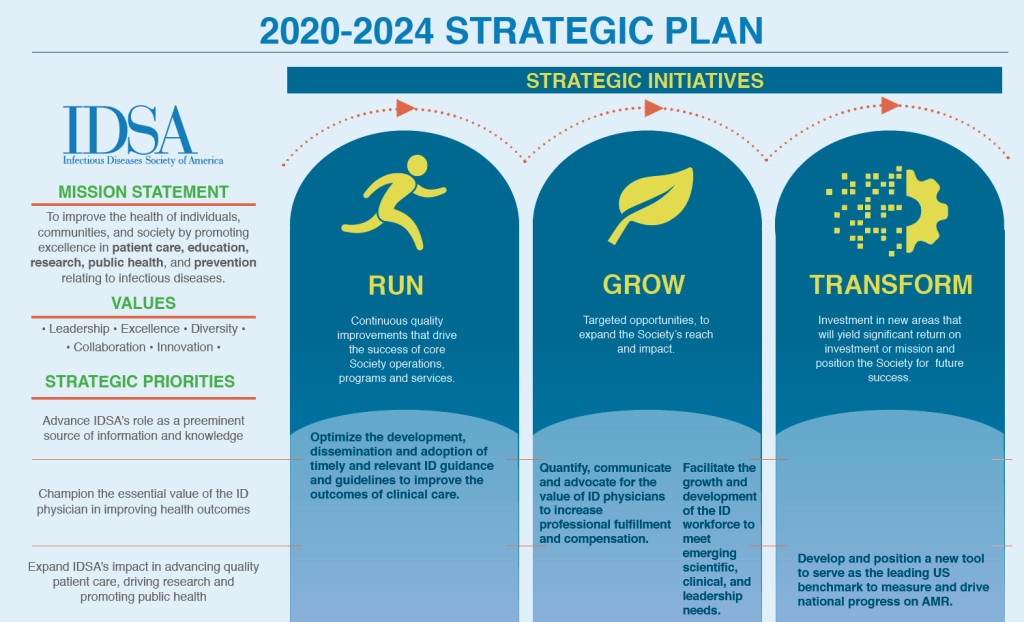
This organization consists of more than 12,000 physicians, scientists and public health experts who focuses in infectious diseases. Their purpose is to “improve the health of individuals, communities, and society by promoting excellence in patient care, education, research, public health, and prevention relating to infectious diseases”. One of the strategic initiatives of this organization is to develop and position an innovative tool to aid as the top US point of reference to measure and drive national progress on Antimicrobial Resistance (Infectious Diseases Society in America, 2020). In addition, IDSA has formed a program to elect Antimicrobial Stewardship Centers of Excellence (CoE) all throughout the U.S. health care system.

The IDSA Antimicrobial Stewardship Centers of Excellence Program builds upon the criteria set forth in the CDC Core Elements with added features of meaningful differentiation. The Core Criteria for the IDSA Antimicrobial Stewardship Centers of Excellence were established by a workgroup of infectious disease physicians and infectious disease trained pharmacists (Infectious Diseases Society in America, 2020).

2. Association for Professionals in Infection Control and Epidemiology (APIC) Antimicrobial Stewardship

APIC (n.d.) is a leading professional association for infection preventionists with more than 15,000 members consisting of nurses, physicians, public health professionals, epidemiologists, microbiologists, or medical technologists who:

  • Collect, analyze, and interpret health data in order to track infection trends, plan appropriate interventions, measure success, and report relevant data to public health agencies.
  • Establish scientifically based infection prevention practices and collaborate with the healthcare team to assure implementation.
  • Work to prevent healthcare-associated infections (HAIs) in healthcare facilities by isolating sources of infections and limiting their transmission.
  • Educate healthcare personnel and the public about infectious diseases and how to limit their spread.

APIC (n.d.) also holds a public health agenda which includes Antibiotic Resistance. The projected $200 million in funding would: 

  • Expand Hospital acquired infections and antibiotic resistance prevention efforts from 25 states to 50 states, six large cities, and Puerto Rico;
  • Sustain an Antimicrobial Resistance Laboratory Network of up to seven AR Regional Labs to serve as a national resource for cutting-edge lab support to states and characterize emerging resistance;
  • Implement antibiotic stewardship programs that align with CDC’s Core Elements for Antibiotic Stewardship in inpatient, outpatient, and long-term care settings;
  • Drive innovation through the CDC’s Prevention EpiCenters network collaboration with academic research centers conducting applied research on interventions for infection prevention;
  • Incorporate NHSN antibiotic use data to improve prescribing practices. 
Knowing the importance of what the public and private sectors do to help the community is necessary for us healthcare professionals so that we could provide input on these projects that they are implementing and create partnerships to eradicate Antibiotic Resistance.

References

Association for Professionals in Infection Control and Epidemiology. (n.d.). About APIC. Retrieved from https://apic.org/about-apic/about-apic-overview/

Association for Professionals in Infection Control and Epidemiology. (n.d.). Antibiotic Resistance. Retrieved from http://cqrcengage.com/apic/antibioticresistance

Infectious Diseases Society in America. (2020). About IDSA. Retrieved from https://www.idsociety.org/about-idsa/about-idsa/

Infectious Diseases Society in America. (2020). Antimicrobial Stewardship Center of Excellence. Retrieved from https://www.idsociety.org/clinical-practice/antimicrobial-stewardship/

Longest, B. B. (2009). Health Policymaking in the United States: Vol. 5th ed. Health Administration Press.

Patton, R. M., Zalon, M. L., & Ludwick, R. (Eds.). (2014). Nurses making policy: From bedside to boardroom. Retrieved from https://ebookcentral-proquest-com.ezproxy1.lib.asu.edu

PUBLIC SECTOR INSTITUTIONS AND POLICIES

What is a Public Sector?

The public sector is a part of the economy comprised of all levels of government and government-controlled enterprises like public goods and governmental services such as the military, law enforcement, infrastructure (public roads, bridges, tunnels, water supply, sewers, electrical grids, telecommunications, etc.), public transit, public education, along with health care and those working for the government itself, such as elected officials. The public sector also applies public authority or the implementation of public policy. Policymakers from the public sector decide based on a greater sensitivity to the public, the organization and the interest groups (Longest, 2010). Therefore, acknowledging what the public sectors have been doing to prevent Antibiotic Resistance is necessary to promote better Antibiotic Stewardship.

Here are some of the public sectors that promotes Antibiotic Stewardship

Centers for Disease Control and Prevention (CDC) (2020)

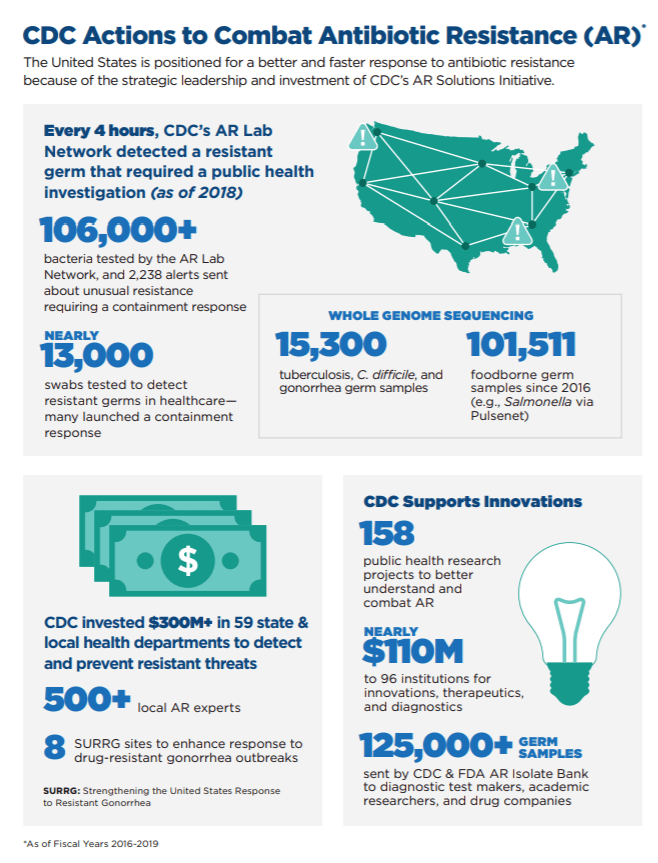
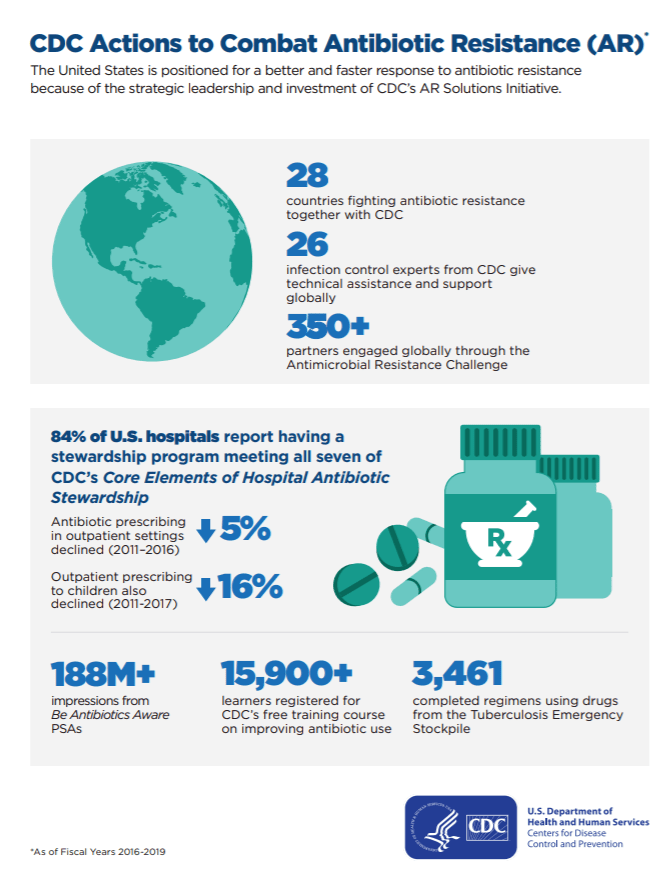
The CDC is one of the public sectors that aims to lead the fight against Antibiotic Resistance hence, the Antibiotic Resistance Solution Initiative was created. This initiative capitalizes in national infrastructure to discover, respond, control, and counteract resistant infections across healthcare settings, food, and communities. CDC funding aids all 50 state health departments, six local health departments, and Puerto Rico and the U.S. Virgin Islands.  

  • Detect, Respond, and Contain Resistant Pathogens through state-of-the-art laboratory and diagnostics offered in all states through CDC’s AR Laboratory Network, and on-the-ground lab expertise and assistance in some countries abroad. In addition, the AR Solution Initiative increases the capability of all states through rapid detection and quicker response to outbreaks and developing resistance related to healthcare-associated infections, foodborne bacteria, and gonorrhea—to contain and control spread.
  • Prevent Spread of Resistant Infections through effective surveillance, prevention and improving antibiotic use.
  • Encourage Innovation for New Strategies, Drugs, and Diagnostics through collaborations with academic and healthcare partners to do research and develop ways to prevent antibiotic resistance.

Arizona Department of Health Services (AZDHS)

            The AZDHS (2016) created the Arizona Health-associated infection plan to support and enhance healthcare associated infection prevention activities like antibiotic stewardship. This is divided into 4 categories: development or enhancement of HAI program infrastructure; surveillance, detection, reporting, and response; prevention; and evaluation, oversight, and communication. AZ DHS has multiple resources in their website regarding antibiotic stewardship programs in long term care facilities and has been promoting the use of CDC’s Core Elements of Antibiotic Stewardship for Nursing Homes.

Policies that the government had issued:

  • Former president Barack Obama released Executive Order 13676 directing federal agencies to implement the recommendations in the President’s Council of Advisors on Science and Technology (PCAST) report and establishing two bodies:
    • Interagency Task Force for Combating Antibiotic-Resistant Bacteria, which is made up of U.S. federal government agencies responsible in executing the National Action Plan and chaired by the Secretaries of the U.S. Departments of Health and Human Services, Agriculture, and Defense
    • Presidential Advisory Council on Combating Antibiotic-Resistant Bacteria (PACCARB), which consist of voting members from non-governmental agencies
  • Centers for Medicare & Medicaid Services (CMS) urged the importance of antibiotic stewardship programs across a variety of clinical practice areas. Therefore, federal regulations § 482.42(b) and § 485.640(b) wherein Hospitals and Critical Access Hospitals must implement Antibiotic Stewardship programs by March 30, 2020.

References

Arizona Department of Health Services. (2016). Healthcare-Associated Infection (HAI) & Antibiotic Resistance. Retrieved from https://azdhs.gov/preparedness/epidemiology-disease-control/healthcare-associated-infection/index.php

Centers for Disease Control and Prevention. (2020). What CDC is doing: Antibiotic Resistance (AR) Solutions Initiative. Retrieved from https://www.cdc.gov/drugresistance/solutions-initiative/index.html

Centers for Medicare & Medicaid Services. (2019). Burden reduction and discharge planning final rules guidance and process. Retrieved from https://www.cms.gov/files/document/burden-reduction-discharge-planning-som-package.pdf

Longest, B.B. Jr. (2010). Health policymaking in the United States (5th ed.). Chicago, IL: Health Administration Press.

HISTORICAL AND CONTEMPORARY ROLE OF INSTITUTIONS RELATED TO ANTIBIOTIC STEWARDSHIP

Legislation is a solution to promote a certain policy but may occur over time due to its complex process. As soon as the policy agenda is set judicially and the problem may be clearly identified, a sequence of well-documented stages in which a bill can become a law in both state and federal legislation. Then again, once a bill is introduced, it might never become a law. During 2011 through 2013, in the 112th Congress, only 2% of proposed bills (284) were passed into law.  Therefore, being aware of the progress of legislation is important to influence the development of a bill like attending public hearings and reaching out to committees (Paton, Zalon & Ludwick, 2014). The United States government has been addressing antibiotic resistance as a national priority, thus, creating strategies to combat antibiotic overuse and misuse (Centers for Disease Control and Prevention, 2019).

History of Antibiotics Resistance and Stewardship

Alexander Fleming discovered Penicillin in 1928 and emphasized that overuse may diminish its efficacy (Gregory, Suleyman & Barnes, 2018). Since then, the concept of Antibiotic Resistance has been acknowledged and the need for Antibiotic Stewardship has been promoted. As a result of overuse and misuse of antibiotics, microorganisms such as bacteria and viruses generate ways to endure new antibiotics making it hard for healthcare organizations and pharmacies to keep up. Consequently, many infectious disease professional organizations have supported plans to eradicate this threat.

Center for Disease Control and Prevention

In 2009, the CDC started the first didactic attempt to encourage improved antibiotic use in acute-care hospitals (Gregory, Suleyman & Barnes, 2018).

https://www.cdc.gov/drugresistance/pdf/threats-report/CDC-Leads-AR-Fight-508.pdf

Joint Commission

On June 2, 2015, The Joint Commission (2016) participated in the White House Forum on Antibiotic Stewardship. Later, the Joint Commission established the antimicrobial stewardship criterion for hospitals, critical access hospitals, nursing care centers, ambulatory care organizations, and office-based surgery practices and did a field review in November and December 2015. Subsequently, the Joint Commission announced a new Medication Management standard 09.01.01 addressing that all hospitals, critical access hospitals, and nursing care centers implement Antimicrobial Stewardship effective January 1, 2017.

Centers for Medicare & Medicaid Services (CMS)

CMS encouraged the importance of antibiotic stewardship programs across a variety of clinical practice areas. Therefore, the creation of federal regulations § 482.42(b) and § 485.640(b) that Antibiotic Stewardship programs must be implemented by March 30, 2020.

Collectively, federal organizations are working together to (CDC, 2019):

Respond to new and ongoing public health threats

Strengthen detection of resistance

Enhance efforts to slow the emergence and spread of resistance

Improve antibiotic use and reporting

Advance development of rapid diagnostics

Enhance infection control measures

Accelerate research on new antibiotics and antibiotic alternatives

As healthcare advocates, our role and involvement to healthcare policymaking can be endless. Our voice and engagement with stakeholders may impact the safety of the society especially in issues like Antibiotic Resistance. Although, there is no specific law that demands the need for Antibiotic Stewardship or any punishment if not followed, it is our duty to strengthen our voice as an advocate for all.

References

Centers for Disease Control and Prevention. (2019). U.S. action to combat antibiotic resistance. Retrieved from https://www.cdc.gov/drugresistance/us-activities.html

Gregory, J. R., Suleyman, S. & Barnes, M. N. (2018). A review of the opportunities and shortcomings of Antibiotic Stewardship. Retrieved from https://www.uspharmacist.com/article/a-review-of-the-opportunities-and-shortcomings-of-antibiotic-stewardship

Patton, R. M., Zalon, M. L., & Ludwick, R. (Eds.). (2014). Nurses making policy: From bedside to boardroom. Retrieved from https://ebookcentral-proquest-com.ezproxy1.lib.asu.edu

The Joint Commission. (2016). Approved: New Antimicrobial Stewardship Standard. Retrieved from https://www.jointcommission.org/-/media/enterprise/tjc/imported-resource-assets/documents/new_antimicrobial_stewardship_standardpdf.pdf?db=web&hash=69307456CCE435B134854392C7FA7D76

Ethical impact of healthcare policy

Ethics play an important role in healthcare policymaking. It guides the legislator in developing or improving policies based on four philosophical principles: Respect for autonomy, justice, beneficence and nonmaleficence (Longest, 2010). Since Antibiotic Resistance have been a growing worldwide issue, the need for policymakers to include ethical considerations is imperative for them to create a law that would benefit the vulnerable population especially long term care facility residents.  Let me discuss to you the following ethical principles that Longest (2010) emphasized which are needed in policymaking:

  1. The principle of respecting the peoples’ autonomy in policymaking is necessary because it gives them the chance to decide based on their own wellbeing. This makes it ethically appropriate as policymakers must ensure the people that the policy was made is truthful and beneficial to all parties.
  2. It is important to consider justice in creating policies focused on healthcare delivery. It is the right of every person to have access to healthcare however, policymakers have to critically think on what a fair distribution of healthcare is. According to Longest (2010), justice has three most prominent views on justice that policymakers must reflect on:
    • Egalitarian – this means that each person must have equal access to healthcare assistance and inconveniences and that justice should be acknowledged in various levels of need. In other words, more benefits or burdens are given to those people who are sicker, extremes of age, poor, homeless etc. since they are vulnerable with diseases.
    • Libertarian – entails a maximum of social and economic freedom for the people which limit governmental interference in distributing healthcare.
    • Utilitarian – involves creating healthcare policies for the greatest good of all
  3. Policymakers who follow the principle of beneficence render choices based on the utmost gain to society as a whole and balance it with the problems of their decisions objectively.
  4. Lastly, policymakers who are driven by the principle of nonmaleficence generate decisions that lessen injury and to safeguard the quality of healthcare given to the society.

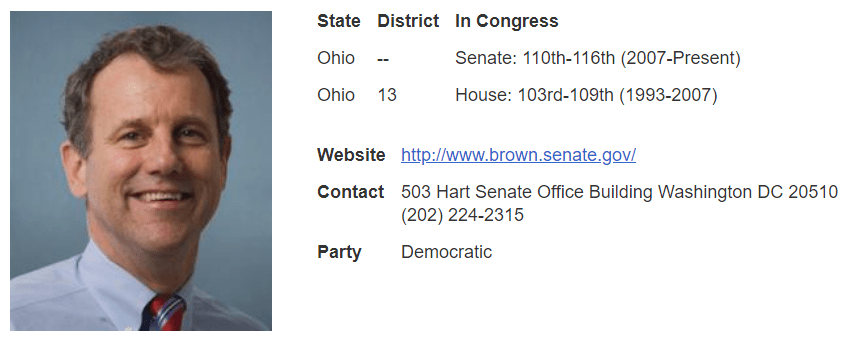
Senator Sherrod Brown from Ohio created a bill that focuses on antibiotic resistance which has now been introduced in the Senate last July 29, 2019. The Strategies to Address Antibiotic Resistance Act or the STAAR Act increases This bill expands numerous proposals to address antibiotic resistance. It also reinstates the interagency Antimicrobial Resistance Task Force to organize and foster attempts to concentrate on antibiotic resistance. Moreover, this bill requires the Department of Health and Human Services to urge health care facilities in executing antimicrobial stewardship programs to appraise and amend the utilization of antimicrobial drugs. On the other hand, this bill also involves the Centers for Disease Control and Prevention (CDC) to utilize the National Healthcare Safety Network to gather and report data about the usage of antibiotic drugs, changes in resistance to such drugs, and other trends influencing patient outcomes. Additionally, the bill increases nationwide efforts to monitor, research, and prevent the spread of infection from resistant organisms (Brown, 2019).

Retrieved from https://www.congress.gov/member/sherrod-brown/B000944?q={%22search%22:[%22antibiotic%22]}&r=3&searchResultViewType=expanded&KWICView=false

            The STARR bill by Senator Brown (2019) was carefully thought out as it considered all four ethical principles in policymaking. It emphasized autonomy as it respects the freedom of the people to know the benefits of Antibiotic resistance and the burden it may cause if not followed. Moreover, justice was highlighted because it showed how antibiotic resistance may affect the those who are considered vulnerable population (elderly in long term care facilities) and the need for initiatives to promote Antibiotic Stewardship should not only be focused on this population but for everyone in the society. Beneficence and nonmaleficence were also accentuated because it promotes goodness and prevent harm to the society by entrusting organizations like the CDC and other government agencies to advocate for better Antibiotic stewardship programs in the United States. Therefore, developing ways to improve antibiotic prescribing in healthcare facilities particularly in those who house vulnerable population like long term care facility residents to counteract antibiotic resistance should be implemented taking into account the ethics behind policymaking.

References

Brown, S. (2019). S.2304 – Strategies to Address Antibiotic Resistance Act. Retrieved from https://www.congress.gov/bill/116th-congress/senate-bill/2304?q=%7B%22search%22%3A%5B%22antibiotic%22%5D%7D&r=3&s=1

Longest, B.B. Jr. (2010). Health policymaking in the United States (5th ed.). Chicago, IL: Health Administration Press.

Introduce Yourself (Example Post)

This is an example post, originally published as part of Blogging University. Enroll in one of our ten programs, and start your blog right.

You’re going to publish a post today. Don’t worry about how your blog looks. Don’t worry if you haven’t given it a name yet, or you’re feeling overwhelmed. Just click the “New Post” button, and tell us why you’re here.

Why do this?

  • Because it gives new readers context. What are you about? Why should they read your blog?
  • Because it will help you focus you own ideas about your blog and what you’d like to do with it.

The post can be short or long, a personal intro to your life or a bloggy mission statement, a manifesto for the future or a simple outline of your the types of things you hope to publish.

To help you get started, here are a few questions:

  • Why are you blogging publicly, rather than keeping a personal journal?
  • What topics do you think you’ll write about?
  • Who would you love to connect with via your blog?
  • If you blog successfully throughout the next year, what would you hope to have accomplished?

You’re not locked into any of this; one of the wonderful things about blogs is how they constantly evolve as we learn, grow, and interact with one another — but it’s good to know where and why you started, and articulating your goals may just give you a few other post ideas.

Can’t think how to get started? Just write the first thing that pops into your head. Anne Lamott, author of a book on writing we love, says that you need to give yourself permission to write a “crappy first draft”. Anne makes a great point — just start writing, and worry about editing it later.

When you’re ready to publish, give your post three to five tags that describe your blog’s focus — writing, photography, fiction, parenting, food, cars, movies, sports, whatever. These tags will help others who care about your topics find you in the Reader. Make sure one of the tags is “zerotohero,” so other new bloggers can find you, too.

Design a site like this with WordPress.com
Get started