What is a Public Sector?

The public sector is a part of the economy comprised of all levels of government and government-controlled enterprises like public goods and governmental services such as the military, law enforcement, infrastructure (public roads, bridges, tunnels, water supply, sewers, electrical grids, telecommunications, etc.), public transit, public education, along with health care and those working for the government itself, such as elected officials. The public sector also applies public authority or the implementation of public policy. Policymakers from the public sector decide based on a greater sensitivity to the public, the organization and the interest groups (Longest, 2010). Therefore, acknowledging what the public sectors have been doing to prevent Antibiotic Resistance is necessary to promote better Antibiotic Stewardship.
Here are some of the public sectors that promotes Antibiotic Stewardship
Centers for Disease Control and Prevention (CDC) (2020)
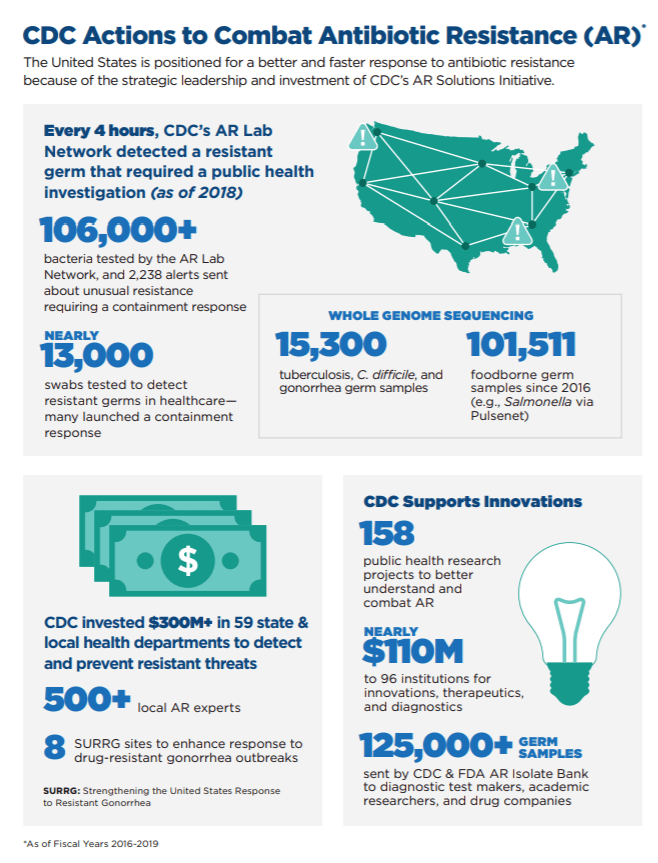
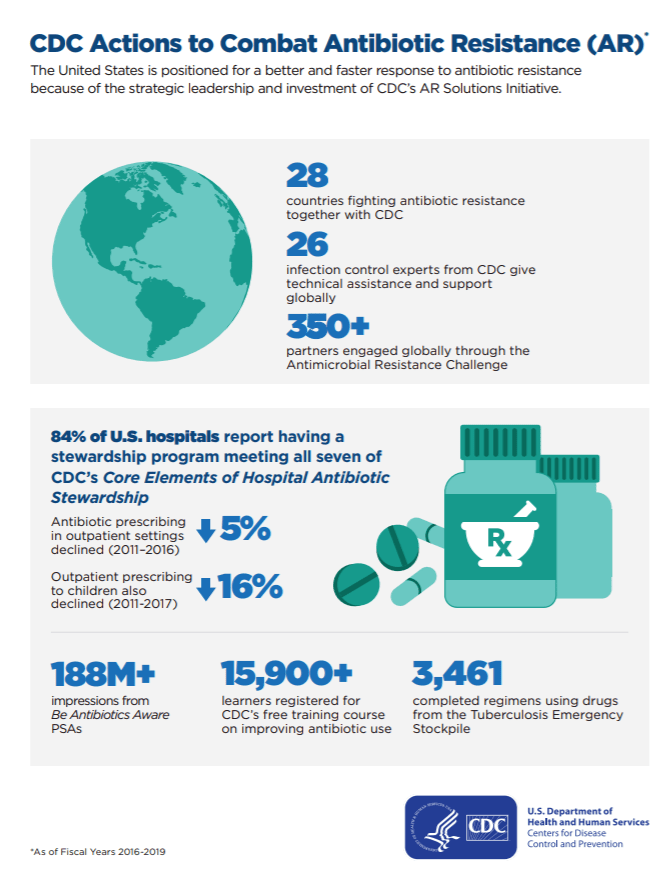
The CDC is one of the public sectors that aims to lead the fight against Antibiotic Resistance hence, the Antibiotic Resistance Solution Initiative was created. This initiative capitalizes in national infrastructure to discover, respond, control, and counteract resistant infections across healthcare settings, food, and communities. CDC funding aids all 50 state health departments, six local health departments, and Puerto Rico and the U.S. Virgin Islands.
- Detect, Respond, and Contain Resistant Pathogens through state-of-the-art laboratory and diagnostics offered in all states through CDC’s AR Laboratory Network, and on-the-ground lab expertise and assistance in some countries abroad. In addition, the AR Solution Initiative increases the capability of all states through rapid detection and quicker response to outbreaks and developing resistance related to healthcare-associated infections, foodborne bacteria, and gonorrhea—to contain and control spread.
- Prevent Spread of Resistant Infections through effective surveillance, prevention and improving antibiotic use.
- Encourage Innovation for New Strategies, Drugs, and Diagnostics through collaborations with academic and healthcare partners to do research and develop ways to prevent antibiotic resistance.
Arizona Department of Health Services (AZDHS)
The AZDHS (2016) created the Arizona Health-associated infection plan to support and enhance healthcare associated infection prevention activities like antibiotic stewardship. This is divided into 4 categories: development or enhancement of HAI program infrastructure; surveillance, detection, reporting, and response; prevention; and evaluation, oversight, and communication. AZ DHS has multiple resources in their website regarding antibiotic stewardship programs in long term care facilities and has been promoting the use of CDC’s Core Elements of Antibiotic Stewardship for Nursing Homes.
Policies that the government had issued:
- Former president Barack Obama released Executive Order 13676 directing federal agencies to implement the recommendations in the President’s Council of Advisors on Science and Technology (PCAST) report and establishing two bodies:
- Interagency Task Force for Combating Antibiotic-Resistant Bacteria, which is made up of U.S. federal government agencies responsible in executing the National Action Plan and chaired by the Secretaries of the U.S. Departments of Health and Human Services, Agriculture, and Defense
- Presidential Advisory Council on Combating Antibiotic-Resistant Bacteria (PACCARB), which consist of voting members from non-governmental agencies
- Centers for Medicare & Medicaid Services (CMS) urged the importance of antibiotic stewardship programs across a variety of clinical practice areas. Therefore, federal regulations § 482.42(b) and § 485.640(b) wherein Hospitals and Critical Access Hospitals must implement Antibiotic Stewardship programs by March 30, 2020.
References
Arizona Department of Health Services. (2016). Healthcare-Associated Infection (HAI) & Antibiotic Resistance. Retrieved from https://azdhs.gov/preparedness/epidemiology-disease-control/healthcare-associated-infection/index.php
Centers for Disease Control and Prevention. (2020). What CDC is doing: Antibiotic Resistance (AR) Solutions Initiative. Retrieved from https://www.cdc.gov/drugresistance/solutions-initiative/index.html
Centers for Medicare & Medicaid Services. (2019). Burden reduction and discharge planning final rules guidance and process. Retrieved from https://www.cms.gov/files/document/burden-reduction-discharge-planning-som-package.pdf
Longest, B.B. Jr. (2010). Health policymaking in the United States (5th ed.). Chicago, IL: Health Administration Press.
 Antibiotic Resistance in long-term care facilities in Arizona
We’re taught as future nurse practitioners to be conscious of appropriate antibiotic use, but we see antibiotic misuse outside of the classroom. In the hospital I see antibiotics being prescribed unnecessarily, so your mentioning of an antibiotic stewardship program becoming a requirement for CMS participating hospitals intrigued me. Also, the deadline of 3/30/2020 is approaching quickly. I looked further into the program requirements, and they are quite extensive. Requirements include having a qualified individual(s) through education lead the program, coordination amongst all departments of the hospital on evidence based antibiotics usage, continual documentation of improvements in proper antibiotic use, and constant surveillance of antibiotic use, to name a few (Centers for Medicare & Medicaid Service [CMS], 2019). I am interested to see how this changes current practice in hospitals, and how the program will be implemented. I foresee compliance issues being a problem for some time in the beginning, but hopefully the lack of CMS reimbursement will encourage hospitals to maintain effective programs.
Reference
Centers for Medicare & Medicaid Services. (2019). Burden reduction and discharge planning final rules guidance and process. Retrieved from https://www.cms.gov/files/document/burden-reduction-discharge-planning-som-package.pdf
LikeLike
Hello,
Thank you for addressing a very important health issue. You did a very good job in defining public sector and the influences of the public sectors on Antibiotic Stewardship program. I had witnessed antibiotics being prescribed unnecessarily to patients and it affects patient’s morbidity and mortality. It is very important for all healthcare facilities to implement the Antibiotic Stewardship programs to promote better patients’ health outcomes. The Centers for Medicare & Medicaid Services (CMS) have taken into action in implementing the program as the regulations regarding Antibiotic Stewardship programs for hospital will be effective on March 30, 2020 (CMS, 2019). This will provide optimal patient outcomes and preserve antimicrobials for future use (File, Srinivasn, & Barllett, 2014).
References
Centers for Medicare & Medicaid Services. (2019). Burden reduction and discharge planning final rules guidance and process. Retrieved from https://www.cms.gov/files/document/burden-reduction-discharge-planning-som-package.pdf
File, T. M., Srinivasan. A., & Bartlett, J. G. (2014). Antimicrobial stewardship: Importance for patient and public health. Clin Infect Dis, 59 (3): S93-S96. doi: 10.1093/cid/ciu543
LikeLike